CYNDER · RESEARCH PUBLICATION
Cynder Economic and System Whitepaper
Cynder: paid off-chain execution, bounded by evidence
A candid account of what the pinned Cynder source implements, what its payment evidence proves, and why service economics must stand before CYNDER.
Publication identity
| Field | Value |
|---|---|
| Document | Cynder economic and system whitepaper candidate 0.3.0 |
| Prepared | 2026-09-01 |
| Evidence cutoff | 2026-08-31 |
| Repository authority | f6039212ff23394b4ff6aa4bbbcc862874f16194; baseline 066615e5d883120312622905ce5538d30a09e88c |
| Model authority | cynder-tokenomics-conservation-v2@88e588d507ca4a080499649d3b3471f2accf3a49 |
| Scope | Conceptual and economic; non-normative; not an offering document |
| Publication | Unpublished candidate; approval and production synchronization not claimed |
| Prepared by | Wren Ashford from the supplied Cynder source corpus; human approval not recorded |
DESIGN
Abstract
Cynder's pinned source describes an off-chain Kubernetes and Knative action service. One cynderd process coordinates authorization, payment checks, persistent action state, and DEPLOY, INVOKE, and DELETE execution. x402 v2 exact USDC settlement on Base precedes workload execution. Base provides payment settlement evidence; provider infrastructure performs the workload.
That boundary is narrower than a decentralized compute-network claim. The source does not establish a live deployment, replicated coordination, generic computation correctness, a CYNDER token, custom production settlement contracts, staking, liquidity, or governance. This paper keeps those absences visible instead of treating future mechanisms as current architecture.
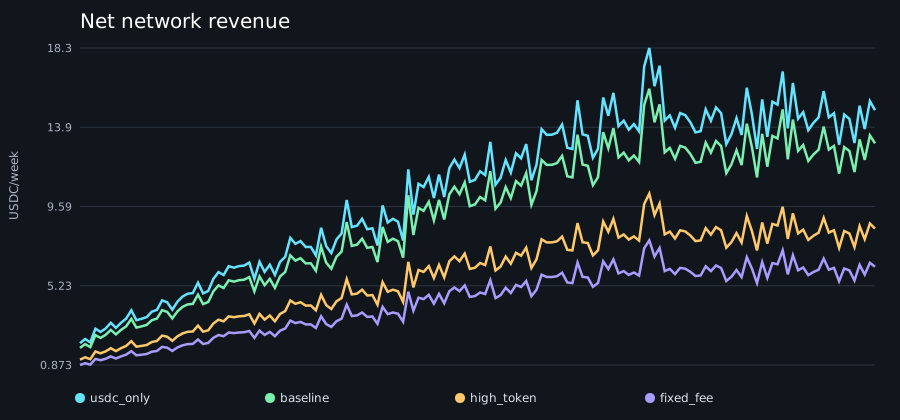
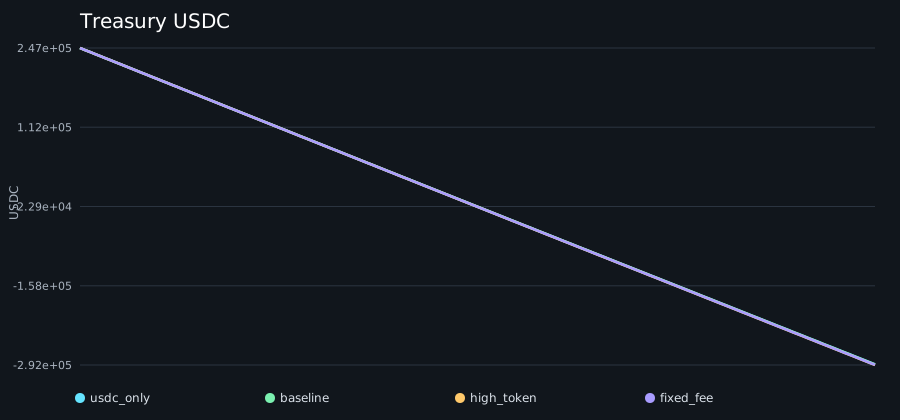
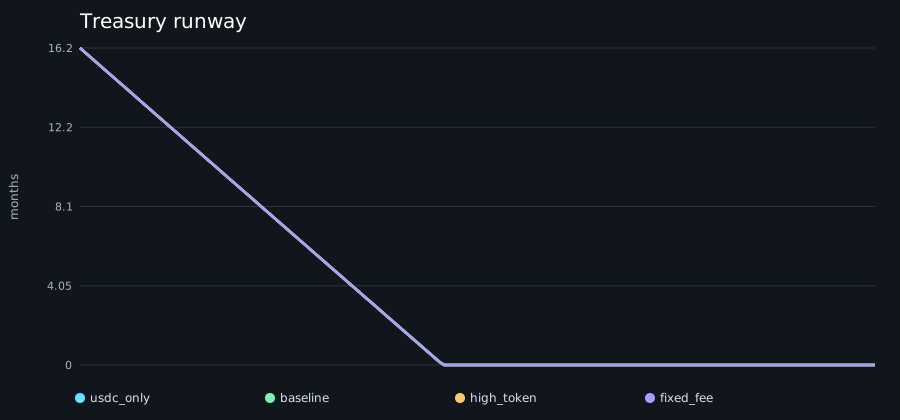
The frozen economic model is likewise a conditional instrument, not a forecast. Under its assumed $3,500 weekly operating cost, both the USDC-only and candidate-token cases reach modeled insolvency in week 71 and end near negative $291 thousand after 36 months. The evidence therefore does not show that adding CYNDER repairs the underlying service-economics deficit. The immediate task is measurement: operation-level cost, customer price tolerance, provider payout requirements, failure costs, and non-token runway.
Claim legend
| Label | Meaning |
|---|---|
| IMPLEMENTED_PINNED_SOURCE | Code or source behavior at the named revision; deployment not implied |
| MODELED | Conditional output from the frozen model and declared assumptions |
| DESIGN / PROPOSED | Conceptual direction, not implementation or approval |
| DEFERRED | Deliberately outside the evidenced current system |
| HYPOTHETICAL | Illustrative trace or value, never observed fact |
| UNKNOWN | Material state not established by the corpus |
Section 1
Problem and Scope
The service problem comes before the network claim
Cynder must prove one useful, paid service transaction before scale, decentralization, or token utility can mean anything.
UNKNOWN
1.1A bounded problem
The source establishes operation classes, not product-market fit. A caller can request a deployment, invoke a deployed service, or delete it through an authenticated and paid control path. The underlying product question remains: which user needs this boundary badly enough to pay a sustainable price, and why is the Cynder path better for that exact job than centralized serverless or self-hosted Knative?
The corpus contains no primary customer research, observed demand, willingness-to-pay study, or supported first-workload record. This paper therefore does not claim a market wedge. It uses an illustrative stateless HTTP image transformation only to make lifecycle and failure questions concrete. That example is hypothetical and should be replaced by a real trace when evidence exists.
1.2Operation classes at the source boundary
| Operation | Service meaning | Evidence limit |
|---|---|---|
| DEPLOY | Create or update a bounded workload revision | Source behavior; no live customer deployment established |
| INVOKE | Call a deployed HTTP service | Source behavior; no measured latency, correctness, or demand established |
| DELETE | Remove a deployment through the paid action path | Source behavior; cleanup and refund semantics remain bounded by implementation |
1.3Neutral alternatives
| Alternative | What it can provide | What this paper does not establish |
|---|---|---|
| Centralized serverless | Managed admission, execution, billing and support | That Cynder is cheaper, faster, safer, or easier |
| Self-hosted Knative | Direct workload control and existing Kubernetes operations | That Cynder reduces total operational burden |
| Centralized compute marketplace | Provider procurement with centralized settlement and enforcement | That distributed providers improve service quality |
| On-chain computation | Consensus-visible execution for highly constrained programs | Suitability for Cynder's OCI workloads |
| USDC-only Cynder service | Stable payment with no native-token conversion | That CYNDER adds necessary service behavior |
1.4Non-goals
- Base does not execute Cynder containers.
- This paper does not claim generic proof of correct computation.
- Ordinary containers do not automatically provide confidentiality.
- No token sale, fundraising, exchange, yield, or appreciation case is presented.
- Roadmap sequencing and normative wire behavior live in separate authorities.
Section 2
System Boundary
Base settles value; Cynder coordinates; providers execute
The three layers do different work and carry different trust.
IMPLEMENTED PINNED SOURCE
2.1Pinned implementation snapshot
At repository candidate f6039212ff23394b4ff6aa4bbbcc862874f16194, one cynderd process owns one Badger directory and coordinates the action lifecycle. DEPLOY, INVOKE and DELETE are independently priced. The service binds an authorized action to payment evidence, persists state, calls Kubernetes and Knative operations, and records receipts.
This is a source boundary, not a deployment boundary. The corpus does not show how many processes are running, where they run, which Base environment is configured, who controls the payment recipient, or whether any customer workload has reached a live service. The architecture is therefore described as implemented in pinned source—not observed in production.
2.2Three-layer boundary
| Layer | Responsibility | What it does not prove |
|---|---|---|
| Base + USDC | Payment settlement and transaction evidence | Container execution, output correctness, service quality or provider honesty |
| Cynder service plane | Action authorization, payment checks, Badger state, receipts and operation coordination | Replicated coordination, neutral admission, independent verification or production availability |
| Provider Kubernetes/Knative | Off-chain workload deployment and invocation | Consensus-backed correctness, confidentiality or adversarial metering integrity |
2.4Explicit absences
| Not evidenced | Consequence |
|---|---|
| Replicated coordinator or executor protocol | Do not call the source topology a decentralized network |
| Node-signed receipts | Digest binding is not independent executor attestation |
| Four-way economic ledger | Do not present deployer/provider/network/liquidity allocation as current |
| CynderSettlement or production Solidity | Custom contract behavior remains design work |
| CYNDER, staking, liquidity or governance | No current token mechanism exists in the audited repository |
Section 3
Actors, Authority, and Trust
Role names do not prove role separation
The current boundary concentrates several powers in one operator unless evidence shows otherwise.
IMPLEMENTED PINNED SOURCE
3.1Actors and powers
A useful trust model starts with what each actor can do, not with what the role is called. The customer authorizes an action and payment. cynderd can admit or reject it, evaluate payment evidence, persist action state, dispatch a Kubernetes or Knative operation, and report a receipt. The x402 facilitator and Base participate in the payment leg. Provider infrastructure performs the workload. An operator-configured payTo receives settlement at the pinned source boundary.
Several authorities remain unknown: who controls pricing, the settlement recipient, refunds, pause behavior, upgrades, software release, recovery, and custody. Proposed Safe, treasury, settlement-contract, and governance roles are design material. They must not be projected backward into the current source.
3.2Actor and control matrix
| Actor | Assets or powers | Failure / abuse power | Evidence status |
|---|---|---|---|
| Customer / payer | Payment authorization, workload request | Malformed request, replay attempt, irreversible side effect | Role implemented; user evidence unknown |
| cynderd operator | Admission, payment check, state, dispatch, receipt | Censor, misprice, misroute, withhold or equivocate | Combined source role |
| x402 facilitator / Base | Payment verification and settlement path | Outage, delay, reorg or configuration failure | Mechanism present; deployment config unknown |
| Provider infrastructure | OCI image execution and output | Incorrect execution, data exposure, withholding, metering error | Execution integration present; provider topology unknown |
| Registry / image publisher | Workload artifact availability and provenance | Tampering, substitution, unavailability | Dependency; policy unknown |
| Treasury / policy authority | Fees, reserves, optional future allocations | Misallocation, key compromise, policy capture | Current topology unknown; future roles proposed |
3.3Assets requiring protection
| Asset | Why it matters |
|---|---|
| Customer USDC | Must not be confused with protocol revenue before liabilities and refunds |
| Provider payable | Compute reimbursement cannot fund discounts or liquidity |
| Action identity | Payment and execution must remain bound to one authorized operation |
| Workload/image digest | Executor substitution must be detectable |
| Receipts and state | Reconciliation depends on durable, attributable evidence |
| Keys and release authority | One compromised authority can change admission, pricing, custody or software behavior |
Section 4
Paid-Action Lifecycle
One payment and one execution create two outcome domains
A settled payment can coexist with failed, unknown or disputed execution.
IMPLEMENTED PINNED SOURCE
4.1Conceptual lifecycle
The source flow begins with an action intent: method, route, operation type, idempotency key and immutable action digest are bound by EIP-191 authorization. cynderd issues or evaluates the x402 payment requirement, accepts evidence for the bounded action, persists the payment binding and action state, and only then dispatches DEPLOY, INVOKE or DELETE to the off-chain execution plane.
The payment state and execution state must remain separate. Payment may be unseen, observed, accepted, rejected or later require reconciliation. Execution may be pending, running, succeeded, failed or unknown. A paper that collapses both into paid/successful hides who bears the cost of partial work, retries, refunds and external side effects.
4.2Objects and evidence
| Object | Purpose | Open question |
|---|---|---|
| Action intent and digest | Bind the authorized operation | Complete canonical schema and retention |
| x402 requirement / authorization | Define payment needed for the action | Exact environment, recipient, expiry and finality |
| Payment fingerprint | Prevent payment evidence reuse across actions | Cross-process and distributed replay domain |
| Persisted action | Durable intent before uncertain external execution | Recovery and migration behavior |
| Execution state | Record current/terminal operation result | Exact legal transitions and timers |
| Receipt | Bind reported outcome evidence | Signer, correctness and availability guarantees |
HYPOTHETICAL
4.3Hypothetical INVOKE trace
Caller
Requests an invocation for example action ex-001 with a bounded price ceiling.
Synthetic identifier; no live transaction claimed.
cynderd
Binds the action digest and returns the x402 requirement.
Conceptual projection of pinned source behavior.
Payer / facilitator
Supplies payment evidence for the bounded action.
Synthetic payment evidence.
cynderd
Persists payment binding and dispatches the Knative invocation.
Source-backed ordering; example values hypothetical.
Provider
Returns an output or failure to the service plane.
No correctness proof implied.
cynderd
Persists outcome evidence for reconciliation.
Payment and execution terminal states remain distinct.
Evidence basis: CYN-REPO-001
Section 5
Execution Evidence and Failure Semantics
Evidence authenticity is not computation correctness
Each evidence type proves a bounded property—and leaves other properties unresolved.
IMPLEMENTED PINNED SOURCE
5.1Execution and evidence
Kubernetes and Knative provide an execution substrate, not an automatic adversarial proof system. A payment receipt can show a payment transition. An action digest can commit to bytes. A log can record an event under collection assumptions. A signature can attribute a statement to a key. None of those facts alone establishes that the workload ran correctly, produced the intended result, protected secrets, used honest metering or remained available.
The current source provides a useful action and evidence seam, but several service properties remain undefined: runtime isolation, image provenance, secret visibility, egress, trusted metering, dispute and appeal, output verification, retention and side-effect safety. Those unknowns should constrain supported workloads rather than disappear behind generic language.
5.2Evidence taxonomy
| Evidence | Can establish | Does not establish alone |
|---|---|---|
| Payment / settlement receipt | A payment transition under configured rules | Workload success, correctness or service quality |
| Action digest | Commitment to specific action bytes | Correctness or authorization outside its domain |
| Operational log / trace | Reported events under collection assumptions | Tamper-proof or complete history |
| Result digest | Commitment to result bytes | Correctness, provenance or availability |
| Executor signature | A key signed a statement | Physical node identity, honest metering or correct computation |
| Replicated result | Agreement among selected executions | Correctness when replicas collude or share a fault |
HYPOTHETICAL
5.3Hypothetical unknown-outcome failure
cynderd
Accepts bounded payment evidence and persists the invocation.
Source-backed order.
Provider
Begins execution, then the network path fails before a terminal response is observed.
Hypothetical failure.
cynderd
Records an unknown outcome rather than blindly declaring failure or retrying.
Required safety posture; exact implementation must be verified.
Reconciliation authority
Inspects durable state before deciding retry, refund or provider payment.
Authority and policy remain UNKNOWN.
Evidence basis: CYN-REPO-001
5.4Material unknowns
- Runtime class, namespace, service-account, capability and kernel boundary
- Image provenance, registry authentication and patch ownership
- Secret and plaintext visibility across providers
- Trusted metering source, precision and rounding
- Retry and external-side-effect policy
- Dispute, appeal, refund and evidence-retention procedure
Section 6
Settlement and Accounting
USDC pays for service; accounting determines what remains
Gross customer collection is not the same thing as protocol revenue.
IMPLEMENTED PINNED SOURCE
6.1Current settlement boundary
At the pinned source revision, x402 v2 exact USDC behavior on Base precedes DEPLOY, INVOKE and DELETE. Settlement targets an operator-configured payTo. This provides a payment gate and evidence-binding path; it does not by itself allocate provider reimbursement, network revenue, refunds, reserves or future liquidity.
A future four-way accounting split may separate deployer credit, provider credit, network revenue and liquidity reserve. That is DESIGN, not current implementation. Any future ledger must use deterministic integer base units, document remainder handling, protect accrued provider liabilities and reconcile quote, transfer, ledger and payout totals without unexplained variance.
6.2Accounting classes
| Flow | Class | Control |
|---|---|---|
| Customer → settlement recipient | Gross collection | Not protocol revenue until liabilities and restrictions are recognized |
| Provider reimbursement | Restricted liability / pass-through | Cannot fund discounts, rewards or liquidity |
| Base, facilitator and verification costs | Variable service expense | Must be measured and reconciled |
| Network fee | Potential protocol revenue | Realized only after due liabilities and costs |
| Refund / dispute reserve | Restricted reserve | Held until terminal outcome |
| Liquidity or token action | Discretionary future allocation | Permitted only from realized margin after runway and liability floors |
6.3Conservation vocabulary
| Identity | Meaning |
|---|---|
| CustomerCharge | ProviderPayout + PaymentAndBaseCost + VerificationAndDisputeCost + RefundAndFailureReserve + ProtocolNetRevenue + TaxesOrRestrictedAmounts |
| TokenActionBudget | No greater than realized protocol net revenue minus required operating reserve contribution and due liabilities |
| Idempotent reconciliation | A retry cannot duplicate provider payout, network fee or refund |
Section 7
Service Economics
Execution must be viable without token appreciation
Price, provider payout, failure cost and operating burden must reconcile per operation.
UNKNOWN
7.1The missing economic proof
The source includes prices but not a measured cost ledger. Deploy is priced at $0.10, invoke at $0.001 and delete at $0.01 in the pinned fixture. Those values do not establish what a provider spends, what Cynder spends, what failures cost, or whether the resulting contribution margin is positive.
A credible service model must separate deploy, invoke and delete; warm and cold execution; CPU, memory, egress and supported accelerators; successful, retried, timed-out, disputed and refunded operations; and the timing of provider payout. Unknown inputs remain unknown. Assigning zero to egress, support, verification, refunds or payment costs would manufacture viability.
7.2Durable equations
| Measure | Definition |
|---|---|
| Customer charge | Compute charge + network fee + gas pass-through + verification/risk charge + taxes |
| Provider required payout | Resource cost + operating overhead + risk premium + target margin |
| Protocol net revenue | Customer charge − provider payout − Base/payment cost − verification/dispute cost − refund/failure loss − variable service cost − taxes |
| Contribution margin | Protocol net revenue − variable acquisition or support cost |
| Non-token runway | Unrestricted cash and USDC after liabilities divided by net cash burn; treasury CYNDER valued at zero |
7.3Required measurement ledger
| Measure | Minimum evidence |
|---|---|
| Warm/cold invocation | p50/p90/p99 CPU, memory, duration, cold-start and failure observations |
| Deploy/control plane | Kubernetes API, registry, storage, reconciliation and support cost |
| Provider economics | Resource cost, reservation price, utilization floor, payout delay and target margin |
| Failure burden | Retries, timeouts, refunds, disputes, Base/facilitator failure and incident response |
| Customer evidence | Comparable workload, price tolerance, retention and failure acceptance |
Section 8
CYNDER Necessity and the USDC Counterfactual
CYNDER must beat the same-input USDC alternative
A token is not justified merely because it can be inserted into a payment flow.
DEFERRED
8.1Burden of proof
Customers can pay for the evidenced service in USDC. That makes USDC the baseline counterfactual for every proposed CYNDER role. The paper must ask what service property fails without CYNDER, who must acquire or hold it, how long the obligation lasts, who receives it, which realized service margin funds any acquisition or discount, and what rational recipients do when they need stable operating cash.
No CYNDER token, supply schedule, provider reward, liquidity position, staking contract or governance system is evidenced in the audited repository. Candidate values in the model—such as a 10% network-fee-only discount or 25% of realized network revenue to protocol-owned liquidity—are test parameters, not adopted policy.
8.2Same-input counterfactual
| Design | Added behavior | Burden |
|---|---|---|
| USDC-only service | Stable customer payment and provider-value denomination | Measure service margin, failure cost and custody |
| USDC service + ordinary network fee | Explicit protocol revenue without token conversion | Prove fee competitiveness and realized margin |
| USDC service + candidate CYNDER action | Purchase, spend, lock or reserve event | Prove unique service benefit exceeds slippage, custody, tax, volatility and sell-pressure costs |
| CYNDER bond / staking | Potential collateral or admission role | Prove objective fault, durable evidence, appeal, volatility safety and superiority to USDC collateral |
8.3Role test
| Question | Required answer |
|---|---|
| Exact action | Who acquires, holds, spends, locks, burns or transfers CYNDER? |
| Necessity | What service failure occurs if the token is removed? |
| Funding | Which realized non-token margin funds acquisition, discount or reward? |
| Duration | How long is CYNDER rationally held and what releases it? |
| Sell pressure | Who receives CYNDER and how much must they convert to cover costs? |
| Downside | Does the service remain solvent at flat, falling, volatile or illiquid token prices? |
| Kill criterion | Which observation removes or redesigns the role? |
Section 9
Conditional Economic Model
The frozen model is useful because it can fail
The current simulation rejects the idea that token policy alone repairs the assumed service deficit.
MODELED
9.1Reproducibility boundary
The frozen release is cynder-tokenomics-conservation-v2 at source revision 88e588d507ca4a080499649d3b3471f2accf3a49. It uses schema 2.0.0, Python 3.12.3, seed 20260831 and a 156-week horizon. The bundle records 568 pairwise coverage cases, 500 baseline Monte Carlo paths and 17 stress rows.
Its adoption, operating cost, payment mix, provider selling and liquidity inputs are assumptions. The output is not a forecast and does not estimate the probability of Cynder's business succeeding or failing. Its value is comparative: under the same model structure, the candidate token policy does not materially outperform the USDC-only case and neither establishes sustainable service economics.
9.2Selected frozen results
| Scenario or test | Conditional output | Interpretation |
|---|---|---|
| USDC only | Ending treasury −$291,128; insolvency week 71 | The assumed service structure is not solvent without a token |
| Candidate MVI baseline | Ending treasury −$291,532; insolvency week 71 | The token policy does not repair the assumed deficit |
| 500-path baseline Monte Carlo | p05 −$291,601; p50 −$291,551; p95 −$291,499; modeled insolvency 100% | The declared distributions remain tightly centered on insolvency |
| Required volumes through 100,000 tx/day | No tested required-volume case establishes sustainable economics under the cost assumption | Volume alone is not a valid rescue assumption |
| Sensitivity | Operating-cost treasury range $818,874; transactions/day range $44,235 | Measure service cost before tuning token parameters |
Section 10
Security, Concentration, and Falsification
The thesis fails through control, evidence or economics
Unknowns are blockers, not favorable zeroes.
IMPLEMENTED PINNED SOURCE
10.1Current risk posture
The pinned single-daemon boundary concentrates admission, payment evaluation, action state, execution dispatch and receipt production. Payment targets an operator-configured recipient. Receipts are digest-bound but not node-signed. Badger is local to the daemon boundary. These facts make operational evidence possible, but they do not remove operator, storage, custody or software-release trust.
Future mechanisms add their own failure surfaces. Shared settlement introduces signer, upgrade and contract risk. CYNDER introduces conversion, custody, liquidity and policy risk. Staking adds fault-definition and appeal risk. Governance adds capture and emergency-authority risk. None should be activated merely to make the architecture appear more complete.
10.2Threat and failure matrix
| Risk | Current control or evidence | Residual / required response |
|---|---|---|
| Payment-action mismatch or replay | Bound action authorization and payment fingerprinting | Define distributed replay domain, finality and adversarial tests |
| Unknown execution outcome | Durable action state and receipts | No blind retry; define side-effect, refund and reconciliation policy |
| Operator or key compromise | Not established by corpus | Inventory keys, recipients, pricing, pause, upgrade and recovery authority |
| Hostile workload / image tampering | Kubernetes/Knative integration | Define immutable digest, registry, isolation, secret and egress policy |
| Provider misexecution or withholding | Operational evidence seam | Define verification mode, availability, dispute and compensation |
| Base / facilitator outage or reorg | Payment evidence path | Define provisional execution, finality, retry and duplicate-economic-outcome handling |
| Negative contribution margin | Frozen model exposes deficit under assumptions | Measure costs and reject scale or token policy that cannot cover service |
| Thin token liquidity / structural selling | Modeled scenarios only | Do not activate token path without observed depth and sell-pressure evidence |
10.3Falsification conditions
- Measured provider payout plus variable service cost persistently exceeds customer charge.
- Positive margin depends on below-cost provider compensation or token appreciation.
- Payment evidence cannot be bound and reconciled to one operation without duplicate economic outcomes.
- A proposed CYNDER role has no unique benefit over USDC after conversion and liquidity costs.
- Provider or reward-recipient sales exceed genuine CYNDER acquisition and holding demand.
- The model requires permanently rising volume or price to avoid insolvency.
- Control concentration or custody cannot be bounded to an acceptable failure and recovery model.
Section 11
Evidence, Reproducibility, and Conclusion
Evidence, references and the next honest iteration
The paper freezes a bounded argument; the specification, roadmap, model and deployed reality retain separate authority.
DESIGN
11.1Conclusion
At the audited source boundary, Cynder is a single-daemon, Badger-backed service for paid off-chain Kubernetes and Knative actions. x402 exact USDC behavior on Base gates execution. The design creates an auditable seam between authorization, payment evidence, persistent action state and provider execution, while leaving correctness, decentralization, custody, service economics and deployment truth unresolved.
The frozen model's negative result is not an embarrassment to hide. Under its assumptions, neither the USDC-only nor candidate-token case establishes sustainable economics, and adding the candidate token policy does not repair the modeled deficit. That conclusion directs the next iteration toward measurement rather than promotion.
CYNDER remains deferred until a precise role demonstrates a necessary service benefit over the same-input USDC design, survives provider selling and severe price/liquidity stress, and is funded from realized margin after liabilities and reserve needs. If that evidence does not emerge, the honest outcome is to retain a USDC service and reject the token role.
11.2Document authority crosswalk
| Question | Sole authority |
|---|---|
| Conceptual and economic thesis | This versioned whitepaper candidate and its claim ledger |
| Wire behavior and conformance | Versioned normative protocol specification |
| Delivery sequencing and status | Living Cynder roadmap |
| Quantitative scenarios | Frozen model release and reproducible workbench |
| What is deployed | Versioned deployment manifest plus observed proof |
| Who approved activation | Signed human decision and change-control record |
11.3Research sources
| Source | Use in this paper | Prohibited inference |
|---|---|---|
| Pinned repository package | Current source behavior and explicit absences | Live deployment, production security or adoption |
| Frozen simulation release | Conditional comparative results | Forecast, policy approval or observed economics |
| Settlement and coordination briefs | Proposed architecture and future seams | Current implementation |
| Ethereum historical paper | Argumentative structure and historical context | Current Base or Cynder behavior |
| Akash historical materials | Procurement-to-deployment and on/off-chain boundary precedent | Cynder token necessity |
| Golem historical paper | Role-driven market and candid residual-risk precedent | Cynder demand or economics |
11.4Reproduction bundle
| Artifact | Purpose |
|---|---|
| research/source-ledger.json | Source IDs, authority classes and scope |
| research/claim-ledger.json | Atomic claims, locators, limitations and review triggers |
| csv/simulation-manifest.json | Model identity, seed, horizon, coverage and declared source-output digests |
| csv/projection-manifest.json | Delivered table digests, declared-digest comparison and provenance exceptions |
| csv/core_summary.csv | USDC-only and candidate core outcomes |
| csv/monte_carlo_summary.csv | Baseline distribution summary retained with the source model outputs |
| csv/sensitivity.csv | Five tested sensitivity ranges |
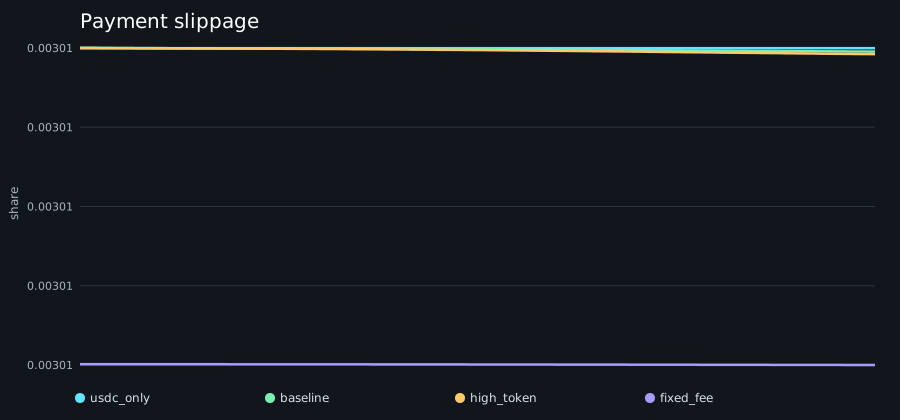
| csv/liquidity_depth.csv | Simplified conditional slippage table |
| csv/weekly_timeseries.csv | 156-week scenario rows used by the cited charts |
| research/*.md | Pinned source package, design briefs and historical research notes |
11.5Gaps to fill through iteration
- Replace the hypothetical workload with one real customer/use-case trace.
- Add measured deploy, invoke and delete cost distributions and provider payout evidence.
- Freeze exact Base, USDC, x402, recipient, custody and finality configuration in a deployment manifest.
- Define runtime isolation, secret, egress, image-provenance and incident-response boundaries.
- Record one real happy path and one consequential failure trace.
- Map conceptual invariants to normative specification IDs and conformance tests.
- Run independent technical, security, economic, editorial and legal-scope review before publication.
SOURCE REGISTER
References
Repository and model sources are version-bound. Ethereum, Akash, and Golem are used as historical and editorial precedents only; they do not establish current Cynder behavior.
- [1]Pinned Cynder repository economic design package
Repository candidate f6039212ff23394b4ff6aa4bbbcc862874f16194; observed baseline 066615e5d883120312622905ce5538d30a09e88c.
CYN-REPO-001· pinned_repository_package · research/repository-economic-design-package.md - [2]Frozen Cynder conservation model release
cynder-tokenomics-conservation-v2@88e588d507ca4a080499649d3b3471f2accf3a49; seed 20260831; 156 weeks.
CYN-MODEL-001· frozen_simulation · csv/simulation-manifest.json - [3]Smart-contract and settlement architecture brief
Proposed architecture only; no deployment or approval implied.
CYN-DESIGN-SETTLEMENT· design_brief · research/smart-contract-architecture-brief.md - [4]Three-node coordination brief
Future implementation contract; conflicts with current single-daemon topology if read as current.
CYN-DESIGN-COORD· future_design_brief · research/three-node-coordination-brief.md - [5]Ethereum historical whitepaper research note
Editorial precedent only.
CYN-HIST-ETH· historical_exemplar · research/ethereum.md - [6]Akash historical whitepaper research note
Editorial and boundary precedent only.
CYN-HIST-AKASH· historical_exemplar · research/akash.md - [7]Golem historical whitepaper research note
Editorial and risk-disclosure precedent only.
CYN-HIST-GOLEM· historical_exemplar · research/golem.md